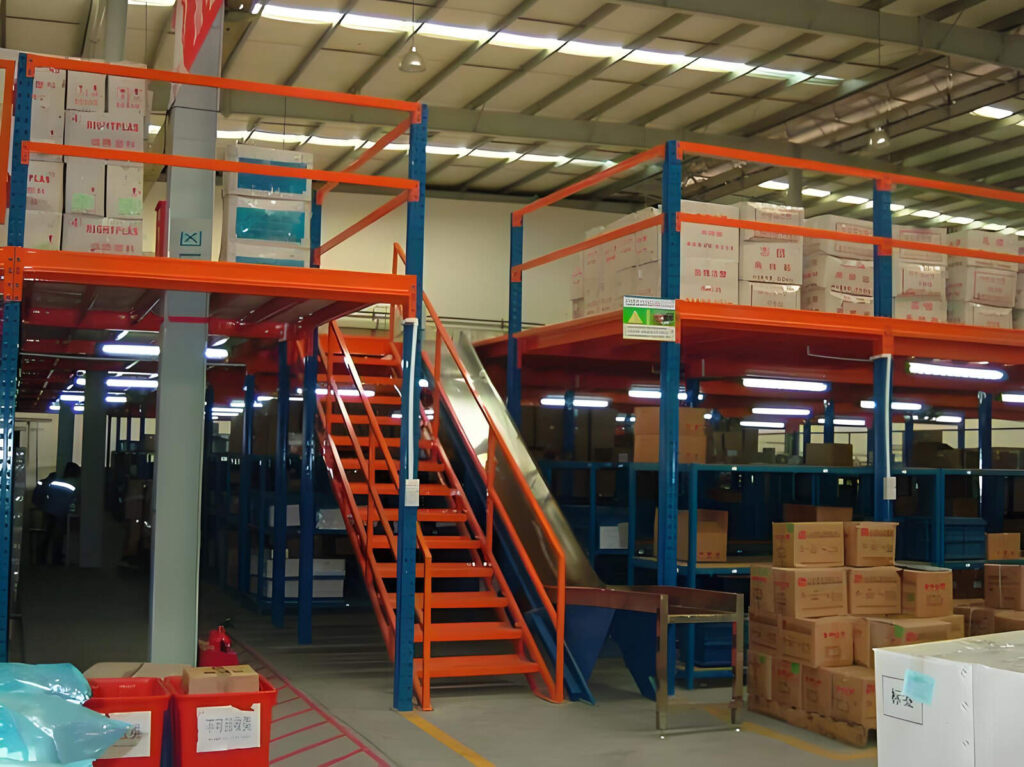
Mezzanine Applications
Mezzanines are versatile structures with a wide range of applications. They can be used for storing unused materials, providing walking space for workers and guests, adding seating in auditoriums, creating additional floor space, and serving as office floors and ceilings. For instance, a small ground-floor office can be constructed beneath a mezzanine, where the mezzanine floor doubles as the office ceiling and a storage platform. Similarly, an in-plant office can be built on top of a mezzanine platform, freeing up the space below for storage or other purposes. Regardless of their configuration, all mezzanine systems prioritize worker safety.
Mezzanines are valuable assets for various service companies, spanning manufacturing, supply, and distribution sectors, as well as non-industrial clients. Industries that benefit from mezzanines include aerospace, agriculture, auto repair and maintenance, education, food and beverage, healthcare, manufacturing, office, outdoor recreation, retail, and transportation.
History of Mezzanines
The term “mezzanine” traces its origins to French, which borrowed it from the Italian word “mezzanino,” a diminutive of “mezzano,” meaning “middle.” Before the Industrial Revolution, mezzanines were mainly found in theaters. However, in the mid-1800s, the advent of the first department stores introduced a new purpose for mezzanines, transforming them into additional store levels. As the Industrial Revolution progressed, manufacturers began incorporating mezzanines into their facilities to optimize storage and create extra usable space. Today, mezzanines continue to serve similar functions but have expanded to various applications and now include features such as conveyors and lifts.
How Mezzanines Work
Modern mezzanines are generally fixed structures, but some are equipped with lift or conveyor systems to move people or items. These systems operate based on commands from automated or semi-automated technology.
What are Mezzanines Used for?
Mezzanines are typically installed in buildings with high ceilings, such as warehouses, offices, and factories. This solution is ideal for companies looking to expand operations without the immediate investment in new buildings. Adding a mezzanine is a cost-effective way to create additional space for offices, storage, and work areas.
Various types of mezzanines are designed for different applications. In industrial settings, they provide extra workspace for light equipment and machinery, including industrial pumps, mist collectors, tanks, HVAC equipment, and conveyor systems. To enhance accessibility and convenience, some mezzanines are engineered with adjustable heights and deck layouts.
When installing a mezzanine, it is crucial to first determine its intended use. This is because key design elements such as load requirements, materials, construction methods, and structural design are all influenced by its purpose.
After establishing the mezzanine’s purpose, the next step is to carefully plan the placement of personnel, walls, and equipment to optimize workflow. When done correctly, a well-planned mezzanine can significantly enhance overall productivity and efficiency.
Common Uses of Mezzanines
Catwalks
Mezzanines can be transformed into catwalk systems, providing an efficient way to transport inventory without disrupting the main production area. This setup allows materials to be moved overhead, keeping them away from the bustling production lines. Additionally, catwalks can be added to link existing mezzanines, further streamlining logistics.
Catwalks are set up by either suspending them from the ceiling or by attaching them to nearby racks and existing mezzanines. These structures offer easy access over tall machinery and equipment. The flooring of a catwalk mezzanine is typically crafted from anti-slip materials such as expanded sheet metals, grated steel, and solid sheets.
Office Space
Certain mezzanine installations are ideal for transforming into office workspaces without compromising the factory floor. Typically located above the production area, they allow supervisors and engineers to stay close to the action. This setup enhances workflow efficiency by positioning workstations near the production zone. Additionally, it is a cost-effective alternative to constructing a new building.
食品工業
Mezzanines in the food industry are constructed using non-corrosive tubes and food-grade stainless steel, ensuring they are easy to maintain and clean. These mezzanines serve as platforms for cold storage and packaging equipment.
A Platform for Automation Systems
Integrating automation into factories is crucial for advancing the global journey toward Industry 4.0.
Companies with limited space are installing mezzanines to integrate automation seamlessly into their existing factory layouts. This approach allows them to avoid the substantial capital expenditure of constructing an entirely new system. A prime example of this is the installation of overhead conveyor systems, which transport materials autonomously.
Warehousing & Distribution
Modern warehouses boast sophisticated systems for in-house logistics. These efficient facilities employ vertical storage solutions to streamline material handling. By installing a mezzanine, companies can better strategize their inventory management, optimizing both incoming and outgoing goods through the expanded layout.
Mezzanine Types
Due to the diverse range of applications for mezzanines, construction companies provide mezzanine systems in multiple configurations. Here are some examples of the various types of mezzanines available.
Prefabricated Mezzanine
Certain mezzanine applications require nothing more than a compact, straightforward platform for storing supplies or products. In these instances, many operations opt for prefabricated mezzanines. These are pre-designed and partially assembled by manufacturers before customer orders are even placed.
Structural Mezzanine
Structural mezzanines are elevated platforms supported by a mix of the building’s load-bearing structures and additional columns or supports. They can serve as work surfaces for machinery or as storage areas for heavy materials. Typically, structural mezzanines are incorporated into the building during its construction, with their design and purpose pre-planned to meet specific needs.
Free Standing Mezzanine
Freestanding mezzanines, also known as equipment platforms , are typically prefabricated structures that stand independently without relying on wall support. Due to this design, they are often utilized for lighter tasks, such as temporarily storing lightweight materials. One significant benefit of both freestanding and structural mezzanines is that they do not obstruct workers or machinery on lower levels. The supports can be strategically positioned to minimize any disruption to the movement of personnel and equipment.
Free-standing mezzanines are often utilized as equipment platforms, standing independently from the building’s main structure. Their flexibility allows them to be reconfigured as needed. For added stability, their posts can be anchored to the floor.
Perimeter Mezzanine
Perimeter mezzanines are commonly found in factories, warehouses, and other expansive buildings. They provide an excellent vantage point for observing floor operations and facilitate quick movement across a busy or crowded space. Their convenience also makes them ideal for short-term product storage. Additionally, perimeter mezzanines can host visitors or guests during tours. To further aid in transporting products and people, these mezzanines can be outfitted with lift and conveyor systems.
Catwalk Mezzanines
These are installed in warehouses to enhance the capacity of tall racks. The current shelves act as a foundation for the mezzanine structure, and additional support columns can be added to bolster stability between the shelves.
Benefits of Mezzanines
Mezzanines offer a multitude of advantages to their users. Firstly, their incredible versatility allows them to serve various purposes, from additional storage space to pallet rack storage. Manufacturers can customize mezzanine systems to fit almost any environment, and this adaptability also means they come in a wide range of prices. Adding a mezzanine to your facility effectively doubles your available work and storage space, with even larger models providing even more capacity. Many mezzanine systems are modular, allowing them to be easily disassembled, expanded, reduced, or relocated as needed. Additionally, mezzanines provide a way to transform your workspace without significant construction costs or extended downtime, as they can be installed within days rather than weeks or months.