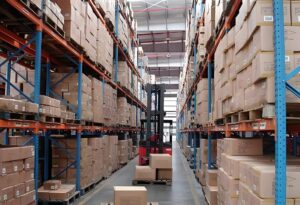
E-commerce shelf types and selection
E-commerce warehouses generally use the following shelf combinations:
Heavy-duty shelves: can bear up to 200kg, suitable for storing home appliances and bulk commodities;
Flow rack: The slide design realizes “first in, first out” and is suitable for high-frequency sorting scenarios;
Automated warehouses: Integrating stacker cranes and AGV robots, storage density increases by 300%. Leading companies have already deployed these systems on a large scale.
E-commerce shelf placement strategy
1. Warehouse layout and traffic flow planning
Core Principles
“No backtracking”: Goods are picked, put on the shelves, and shipped out along the same straight line, avoiding cross-paths and improving order processing efficiency by approximately 35%.
Functional zoning is rigidified: areas are divided into receiving area, sorting area, packaging area, etc. The shelves of best-selling products are no more than 10 meters away from the shipping port, and slow-moving products are placed at the far end of the warehouse, reducing ineffective transportation by 30%.
Channel design: The main channel width is ≥ 2.5 meters (to accommodate two-way forklift traffic), and the auxiliary channel is ≥ 1.2 meters. A circular or linear layout is used to reduce the probability of congestion by 20%.
Shelf layout logic
Adopt a hybrid storage strategy based on SKU characteristics:
Heavy-duty beam shelves (4000kg load-bearing): for storing home appliances and bulk commodities, with column spacing of 1.5-2 meters and customizable floor heights up to 12 meters;
Flow Rack: Equipped with a slide rail automatic replenishment system, it implements “first-in, first-out” sorting for high-frequency SKUs, with a sorting efficiency of 4,000 pieces per hour;
Mezzanine shelves: Double-layer/multi-layer structure for storing small and light items, increasing space utilization by 60%.
2. Classification management and display rules
SKU ranking strategy
Golden display zone: The area 60-120cm from the ground (accounting for 55% of sales), where best-selling and new products are placed first;
Vertical display: Products of the same category are vertically extended to the third or fourth shelf level, increasing consumer shopping efficiency by 18%;
Hot-selling products are placed in front: Promotional products are placed on the shelves at the entrance of the main aisle, combined with the stacking head (1.2×1.2 meters) to form a visual focus.
Smart Replenishment Mechanism
Based on the inventory age analysis system, transfer instructions are automatically triggered for SKUs with inventory-to-sales ratios greater than 1.5, and slow-selling products are moved to the “clearance area” for centralized processing, optimizing inventory turnover by 25%.
3. Technology Empowerment and Efficiency Upgrade
Digital tool applications
WMS Warehousing System: Real-time synchronization of omni-channel inventory data, reducing the mis-delivery rate to 0.03%;
AI visual inventory: Cameras identify out-of-stock status on shelves with 99.5% accuracy, reducing manual inspection costs by 40%.
Green warehousing practices
The use of recyclable metal shelves (carbon footprint reduced by 52%) and the configuration of a photovoltaic power supply system can reduce emissions by 120 tons per warehouse annually.
4. Challenges and Responses
Space utilization bottleneck
Warehouse rents are expected to increase by 12% year-on-year in 2025. The following countermeasures are recommended:
Upward expansion: The height of the three-dimensional shelves exceeds 15 meters, and the storage density is increased by 300%;
Dynamic adjustment: Flexible compression of the spacing between non-core product shelves to 0.8 meters based on the promotion period.
Difficulties in cost control
Traffic costs account for 32% of sales and can be reduced by:
Private domain traffic conversion: WeChat community pre-order model reduces customer acquisition costs by 15%;
Automation reduces costs: AGV robots replace 50% of manual sorting operations.