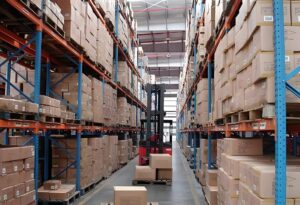
Soorten schappen en selectie voor e-commerce
E-commerce magazijnen gebruiken over het algemeen de volgende schappencombinaties:
Planken voor zwaar gebruik: kunnen tot 200 kg dragen, geschikt voor het opslaan van huishoudelijke apparaten en bulkgoederen;
Doorstroomrek: Het schuifontwerp realiseert “first in, first out” en is geschikt voor sorteerscenario's met een hoge frequentie;
Geautomatiseerde magazijnen: De integratie van magazijnkranen en AGV-robots verhoogt de opslagdichtheid met 300%. Toonaangevende bedrijven hebben deze systemen al op grote schaal geïmplementeerd.
E-commerce strategie voor schappen
1. Magazijnindeling en planning van verkeersstromen
Kernprincipes
“Geen backtracking: Goederen worden verzameld, in de schappen gelegd en verzonden langs dezelfde rechte lijn, waardoor dwarspaden worden vermeden en de efficiëntie van de orderverwerking met ongeveer 35% toeneemt.
De functionele indeling is strikt: gebieden zijn onderverdeeld in ontvangstgebied, sorteergebied, verpakkingsgebied, enz. De schappen van de best verkopende producten zijn niet meer dan 10 meter verwijderd van de verschepingshaven en langzaam bewegende producten worden aan het einde van het magazijn geplaatst, waardoor het transport met 30% minder ineffectief is.
Kanaalontwerp: De hoofdvaargeul is ≥ 2,5 meter breed (voor tweerichtingsvorkheftruckverkeer) en de hulpvaargeul is ≥ 1,2 meter. Er wordt een cirkelvormige of lineaire lay-out gebruikt om de kans op opstoppingen door 20% te verkleinen.
Logica voor schapindeling
Kies voor een hybride opslagstrategie op basis van SKU-kenmerken:
Stalen legbordstellingen voor zwaar gebruik (belastbaar tot 4000 kg): voor het opslaan van huishoudelijke apparaten en bulkgoederen, met een kolomafstand van 1,5-2 meter en aanpasbare vloerhoogtes tot 12 meter;
Flow Rack: Uitgerust met een automatisch aanvullingssysteem met glijrails, implementeert het “first-in, first-out” sorteren voor SKU's met een hoge frequentie, met een sorteerefficiëntie van 4000 stuks per uur;
Tussenplanken: Dubbellaags/meerlaags structuur voor het opbergen van kleine en lichte voorwerpen, waardoor het ruimtegebruik met 60% toeneemt.
2. Classificatiebeheer en weergaveregels
SKU-rangschikkingsstrategie
Gouden weergavezone: De zone op 60-120 cm van de grond (goed voor 55% van de verkoop), waar de best verkopende en nieuwe producten het eerst worden geplaatst;
Verticale weergave: Producten van dezelfde categorie worden verticaal uitgebreid naar het derde of vierde schapniveau, waardoor de consument 18% efficiënter kan winkelen;
Populaire producten worden vooraan geplaatst: Promotionele producten worden op de planken bij de ingang van het hoofdpad geplaatst, gecombineerd met de stapelkop (1,2×1,2 meter) om een visuele focus te vormen.
Slim aanvullingsmechanisme
Op basis van het analysesysteem voor de ouderdom van de inventaris worden automatisch transferinstructies geactiveerd voor SKU's met een inventaris-verkoopratio van meer dan 1,5 en langzaam verkopende producten worden verplaatst naar het “opruimingsgebied” voor gecentraliseerde verwerking, waardoor de voorraadomzet met 25% wordt geoptimaliseerd.
3. Technologie en efficiëntieverbetering
Digitale gereedschapstoepassingen
WMS Warehousing Systeem: Realtime synchronisatie van omnichannel voorraadgegevens, waardoor het percentage verkeerde leveringen tot 0,03% is gedaald;
AI visuele inventarisatie: Camera's identificeren 99,5% nauwkeurig de status van uitverkochte schappen, waardoor de handmatige inspectiekosten met 40% afnemen.
Groene opslagpraktijken
Het gebruik van recyclebare metalen planken (koolstofvoetafdruk verminderd met 52%) en de configuratie van een fotovoltaïsch voedingssysteem kunnen de uitstoot jaarlijks met 120 ton per magazijn verminderen.
4. Uitdagingen en reacties
Knelpunt ruimtegebruik
Verwacht wordt dat de huurprijzen van magazijnen in 2025 met 12% per jaar zullen stijgen. De volgende tegenmaatregelen worden aanbevolen:
Opwaartse uitbreiding: De hoogte van de driedimensionale schappen is meer dan 15 meter en de opslagdichtheid wordt verhoogd met 300%;
Dynamische aanpassing: Flexibele verkleining van de afstand tussen schappen met niet-kernproducten tot 0,8 meter op basis van de promotieperiode.
Moeilijkheden met kostenbeheersing
Verkeerskosten zijn goed voor 32% van de omzet en kunnen worden verlaagd door:
Conversie van privédomeinverkeer: WeChat community pre-order model verlaagt kosten voor klantenwerving met 15%;
Automatisering verlaagt de kosten: AGV-robots vervangen 50% handmatige sorteeroperaties.