
With the high warehousing rent at present, revitalizing the idle space of old warehouses has become a rigid demand for enterprises. Steel structure platform racking has become the optimal solution for old warehouse renovation by virtue of its characteristics of low cost, high adaptability and high efficiency, helping enterprises achieve the goal of doubling storage capacity and reducing operating costs.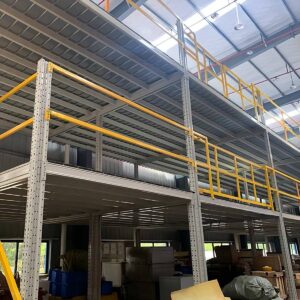
Old warehouses generally have pain points such as insufficient floor height utilization, messy site facilities, and fear of affecting production during renovation. Steel structure platform racking can solve them accurately: the three-dimensional layered design makes full use of the idle upper space, and laser survey customizes the special-shaped layout to bypass columns and pipes to realize no dead angle in space utilization; the lightweight construction process reduces the use of expansion screws by 60%, supports half-warehouse and night construction, and the renovation can be completed in 5-7 days without delaying the normal delivery of enterprises throughout the process.
Its assembled structure can be seamlessly connected with the original shelves without demolishing old facilities, greatly reducing the renovation cost; high-strength steel with reinforced design adapts to the aging problem of old warehouse ground, and supporting facilities such as guardrails and stairs meet the safety supervision standards, eliminating potential safety hazards from the source. In the later stage, according to the development of enterprise business, it can be flexibly demolished, modified and added with layers, and equipped with lifting platforms, sorting slides and other facilities to realize the upgrading of warehousing functions.
Practical cases show that the steel structure platform racking has low renovation cost and fast cost recovery, and most projects can recover the cost within 3 months. More manufacturers provide full-process services of free measurement, design, delivery and installation, turning old warehouses from warehousing burdens into new support for enterprise logistics development.