
1. Selective
The selective pallet rack is a widely used and cost-effective storage solution for warehouses, providing direct access to all loads stored and ensuring maximum efficiency.

It offers various configurations, options for heights and beam sizes, and has been popular since the 1950s due to its affordability and flexibility in meeting different storage needs.
Features
- Clear Aisles of 3 to 3.4m for reach trucks or 3.5 to 4.5m for counter balanced fork lifts
- Supports First in First Out (FIFO)
- Most common mode of racking
- Unfettered access to any pallet
- Allows order picking at lower levels
- Storage Utilisation: 90%
- e.g. for every 100 pallet places available, you can fill 90
When do you use it?
- Where you have a relatively low number of pallets per SKU
- When you want totally free access to any pallet, any time
- When you need to pick from pallets at lower levels
Of course, specific circumstances in your warehouse operation, which might not correspond directly with the conditions mentioned above, might mean that selective racking is an ideal solution for your business.
When not to use it?
- When you have a high number of pallets per SKU and you are constrained for space
- When you need to pick from more pallets than the lower level pick face will allow
2. Push Back Racking
Push back racking is a popular solution in many warehouses because it saves space and increases efficiency. What this does is it allows you to store multiple pallets on one rack, and then access them from the front. It’s perfect for where space is limited and quick access to stock is key.

Push back pallet racking is a high density storage system that uses inclined rails and free rolling carts to store and retrieve pallets. With this racking system, you can store up to 6 pallets deep and access from the front, which makes it ideal for LIFO (Last In First Out) inventory. The key benefits of push back pallet racking are space and density, especially in warehouses and cold stores.
Features
- Clear aisles of 3 to 3.4m
- First in last out (FILO) for each slot
- Can be three or four pallets deep, but commonly only two pallets deep
- Pallets are pushed back from aisle by fork lift trucks
- Pallets are placed on low friction carts
- Used for full pallet storage only
- Forklift drivers need to be careful when loading in an out to avoid pallet damage
- Utilisation: 85-90%
When do you use it?
- When you have more pallets per SKU and want to gain greater storage density
- When order picking is not required from pallets within push back racking
When not to use it?
- When you need to perform order picking from pallets
- When pallets are accessed frequently for picking and are then put away again
- Where pallet to pallet contact is can cause damage to stock
Budget Price: $275-295 per pallet
3. Double Deep Racking
Whilst selective racking is popular for its versatility and ease of access to individual pallets, another effective type is double deep pallet racking, which optimizes storage capacity by utilizing two rows for pallet storage. This system is particularly effective in LIFO inventory systems and can help to minimise aisle space, which allows for more efficient use of warehouse floor area, although it requires forklifts with longer tines for access.
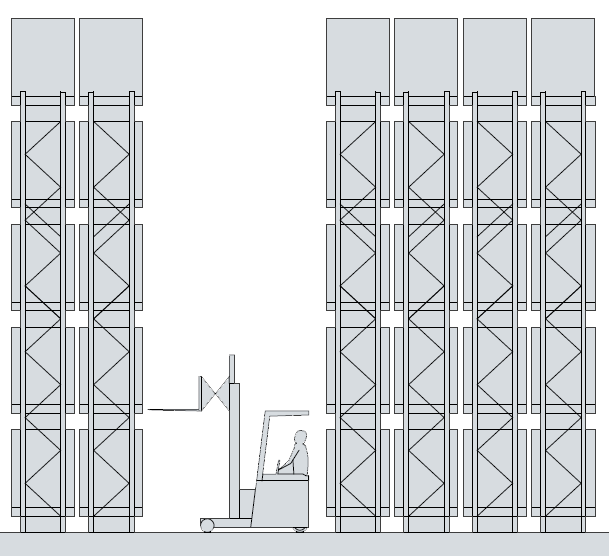
Features
- Clear aisle of 3.0 to 3.4m
- FILO for each slot
- Pallets at lower levels must be on beams, and guide rails are used at upper levels
- Needs a fork lift truck with extendable reach and camera to assist the operator
- Generally used for placing two pallets of the same SKU in each double deep slot
- Can be serviced by reach and counterbalanced fork lift trucks and order picking machines
- Storage Utilisation: 85-90%
When do you use it?
- When you have more pallets per SKU
- When greater storage density is required
When not to use it?
- When you need to perform order picking from pallets
- When pallets are accessed frequently for picking and are then put away again
- When you have lots of SKUs with single pallets in stock
Budget Price: $55-65 per pallet
4. Pallet Live Storage
Pallet Live Storage also known as pallet flow racking is a dynamic storage solution that uses gravity to move pallets from the loading to the unloading point. Great for warehouses that need high density storage and fast inventory turnover. By using inclined gravity roll tracks pallets move to the front of the rack as items are removed, First-In, First-Out (FIFO) inventory management. This maximises storage space and reduces time and effort to access stored goods. Ideal for high volume operations Pallet Live Storage is the go to solution for businesses looking to optimise their warehouse racking and increase storage capacity.

Features
- Clear aisle of 3.0 to 3.4m
- FIFO for each lane
- Pallets are placed on gravity roll tracks and move from entry to exit via gravitational pull
- High use of cube
- One lane per SKU
- Separate load in and load out aisles
- Full pallets only
- Utilisation: 85-90
When do you use it?
- When you need FIFO Operation and stock is moving at relatively fast rate
- When you have a high number of pallets per SKU
- Where you need high space utilisation
When not to use it?
- When you have few pallets per SKU
- When you need to perform order picking
- When you cannot tolerate pallets encountering others due to line pressure
- When you cannot tolerate occasional snags caused by pallets stalling on the roll tracks
Budget Price: $400-420 per pallet
5. Drive in Racking
Drive in racking is a space saving solution that allows forklifts to drive into the storage lanes. It’s great for storing large quantities of the same item and industries with high stock turnover. One of the good things about drive in racking is that it reduces the need for multiple aisles so increases storage density and space utilisation.

Features:
- Clear Aisles of 3 to 3.4m for reach trucks or 3.5 to 4.5m for counter balanced fork lifts
- FILO for each bay
- The fork lift drives down the lane of each racking bay to deposit or pick up pallets
- Drive in racking emulates the operation of block stacking, but with the racking there is reduced damage to pallets and stacking can be higher
- Can be up to 10 or 12 pallets deep and up 6 or 7 pallets high
- Utilisation: 50-60%
When do you use it?
- When FILO is not a problem
- When you do not wish to mix SKUs within each bay/lane of drive in racking
- When high density storage is required, (but be careful of the honeycomb effect) which reduces utilisation
- When staging of received or picked goods is required in a high-density format
When not to use it?
- Where order picking is required from pallets
- When you are planning for greater than 60% space utilisation
Budget Price: $165-180 per pallet
6. Narrow Aisle Racking (Turret Truck Operation)
Narrow aisle racking is a favourite for warehouses that want to make the most of their space and still be able to access everything. This type of racking allows for more floor space by reducing the aisle width between racks. It’s perfect for high turnover warehouses as you can get to your stock quicker and easier.

Narrow aisle turret trucks and articulated trucks are both good for warehouse operations, but they work differently to each other. A turret truck has a rotating mast and fork assembly that can turn 180 degrees while the body stays in the aisle.
These trucks are great in very straight, narrow aisles where they only need to move forward and backward and they can lift higher, often over 50 feet. However, they need excellent floor conditions and precise racking installations to operate safely.
Features
- Clear aisle of 1.8 to 2.2m
- Emulates characteristics of selective racking
- Turret trucks retrieve/put away pallets from pick and deposit (P&D) stations at the end of each bay of racking
- Turret trucks require wire or mechanical guidance down the length of each aisle
- A separate forklift delivers and picks up pallets to and from the P&D stations
- Order picking machines may pick from pallets, but not at the same time as turret trucks
- Only one machine in an aisle at a time
- Utilisation: 90%
When do you use it?
- When you have a high SKUs with relatively small quantities per SKU
- Where you want good space utilisation
- When you have large amounts of goods moving in and out
- When you want to improve the storage density within your warehouse
When not to use it?
- When you can’t afford to have two machines operating
- When you have limited budget
- When you have a high movement velocity and need two machines working in the same aisle at the same time
Budget Price: $50-60 per pallet (not including wire or angle guidance system)
7. Narrow Aisle Racking (Articulated Truck)
Articulated trucks give you an alternative method of handling narrow aisle operations, primarily because they have a pivoting midsection. This gives them that ability to transition from forward travel to sideways stacking without taking up more aisle space than a conventional forklift.
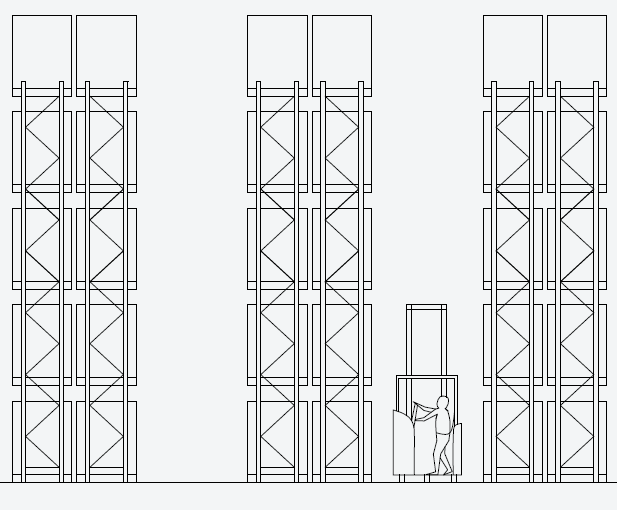
Articulated trucks are particularly good in mixed use facilities where they can move beyond the racking areas. Whilst they don’t quite reach the same heights as turret trucks, they can handle imperfect floors and more flexibility.
Features
- Clear aisle of 1.8 to 2.2m
- Emulates characteristics of selective racking
- Articulated reach trucks can move from truck unloading to rack without the need for (P&D) stations or guidance
- Order picking machines may pick from pallets, but not at the same time as turret trucks
- Only one machine in an aisle at a time
- Utilisation 90%
When do you use it?
- When you have a high SKUs with relatively small quantities per SKU
- Where you want good space utilisation
- When you have large amounts of goods moving and out
- When you want to improve the storage density within your warehouse
When not to use it?
- When you want one machine servicing the racking
- When you have a high movement velocity and need two machines working in the same aisle at the same time
Budget Price: $50-60 per pallet (no guidance required)
8. Mobile Racking
Mobile racking is a solid choice if you need a space saving storage solution for warehouses. By putting racking on wheels, aisles can be reduced and accessed as needed, which helps to increase your warehouse capacity. This is perfect for facilities with limited space and high storage needs.

Features
- Clear aisle of 3 to 3.4m
- Mobile bases with wheels support selective racking
- Operates like a powered compactus
- Mobile racks move to allow access to pallets
- One aisle opens at a time
- Ideal for high density storage, with maximum selectivity
- Often used in cool and cold stores
- Utilisation: 90%
When do you use it?
- Use when there is a high amount of storage, but with modest movement of pallets
- When you are handling full pallets only
- When building and operating expenses are high e.g. cool and cold stores
When not to use it?
- When space is not at a premium
- When you need to perform lots of carton picking from pallets
- When you need operate in more than one aisle at a time
Mobile racking is an expensive solution, but a highly effective one in some warehousing scenarios. If it’s something you are considering for your company, our inventory management consultants can help you with an unbiased cost-benefit analysis, enabling you to make the right decision with total confidence.
Budget Price: $700-800 per pallet
9. Satellite Racking (Deep Lane Pallet Racking)
Satellite racking systems can help to transform the way your warehouse stores products, and by using automated shuttles these systems can increase storage density and retrieval times. It’s a great option for businesses with high turnover and large volumes of stock.

Features
- Clear aisle of 3 to 3.4m
- High density storage system, which utilises a mobile shuttle (remotely controlled) to move the pallets through the racking
- Can be 10 to 40 pallets long per lane
- The shuttles are placed and retrieved from the racking by fork lift trucks
- Can operate in FIFO and FILO modes
- Often used as an alternative to drive in racking, because the utilisation is much higher
- Utilisation: 90 to 95%
When do you use it?
- Used when there is a high volume of products moving through of each SKUs
- One SKU per lane
- Used to overcome the poor space utilisation of drive in racking
When not to use it?
- When you need to pick from the pallets
Budget Price: $185-250 per pallet, $50,000 per shuttle
10. High Rise Racking (Automated Storage and Retrieval Systems)
High Rise Racking systems, also known as Automated Storage and Retrieval Systems (ASRS), are a more advanced pallet racking solution to increase warehouse storage capacity and efficiency. They use automated cranes to store and retrieve pallets, so you can store more in your warehouse whilst making a much smaller footprint.
The high rise design lets you make the most of your vertical space, and it makes it perfect for sites with limited land. ASRS can store one or multiple pallets deep, so you have flexibility in your storage layout. While the initial cost is higher than standard, the long term benefits in efficiency and space usage makes it worth considering for high volume warehouses.

Features
- Clear aisle of 1.8 to 2m
- High density storage system usually serviced by automated cranes. Can be single or multiple pallets deep, open or closed face
- Needs dedicated building, rack clad or free standing
- Utilisation: 90 to 95%
When do you use it?
- Use when land space is limited, and/or if there is a high volume of products moving in and out of the system
- The number of pallets per SKU becomes irrelevant as the system is automatic and all pallets are accessible
When not to use it?
- When budget is limited
- You do not need to pick from pallets (If you do these can be done elsewhere in the distribution centre)
Budget Price: $350-400 per pallet. But don’t forget the price of the building $950-1000/sqm.
Rack Up the Savings with Improved Inventory Management
Improving inventory control and management is one of the fastest routes to end-to-end supply chain cost reduction, and your choice of warehouse storage systems is a crucial element in the success of your IM strategy.
Of course, there is a lot more to effective inventory management than the way your store your pallets, and at Logistics Bureau, we offer a comprehensive portfolio of IM services to help you with all aspects of the challenge.
From diagnostics to direct intervention, our consultants can provide you with the impartial support that equipment, software, and solutions vendors have no incentive to offer. In return for our fees, we deliver genuine value through recommendations that are right for your business, not for any partners on the supply side.
We even offer an initial no-obligation, inventory management consultation free of charge, during which we’ll review your storage or other IM-related situation, identify the key issues to resolve, and help you develop an action plan to address them.