1.Storage Method Selection
Specialized Racking for Rolled Fabrics
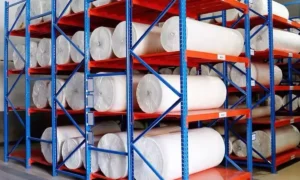
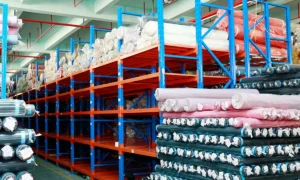
Use fabric cage racks or custom column-type pallet stacking racks to secure rolled fabrics within the cage structure, preventing them from rolling or falling.
New smart racks offer adjustable layers to accommodate different roll diameters, preventing deformation caused by stacking multiple layers.
Pallet Racking Compatibility Solutions
Heavy fabrics can be placed on pallets and stored with beam-type racks. Ensure that the pallets are compatible with the forklift’s operating path.
Control the speed of the forklift when operating it to avoid sudden stops that could cause the pallet to tip.
2. Classification and Labeling Management
Zoning by Attribute
Storage areas are divided according to fabric material, color, and batch, and information is marked on smart shelf labels.
Highly used fabrics should be placed near the exit or on the lower shelves.
Dynamic Adjustment Mechanism
Seasonal or popular fabrics should be prioritized for easy access to minimize manual handling time.
3. Optimizing Space Utilization
Vertical Storage Strategies
Use high-bay racking (such as narrow aisle or shuttle racking) to improve warehouse height utilization.
A tiered design for smart racking can increase storage capacity by 2-3 times that of traditional flat racking.
Stacking and Aisle Planning
Column-type pallet stacking racks support stacking, saving horizontal space.
The width of the main aisle must meet the forklift turning radius, and auxiliary aisles should be adjusted based on access frequency.
4. Safety and Stability Requirements
Anti-Tipping Measures
Pallet racks require regular inspection of pallet stability and installation of guardrails if necessary.
Cage racks for fabrics require secure connections between the cage and the rack.
Operational Specifications
Use a climbing platform for manual storage and retrieval; climbing directly on the shelf is prohibited.
Automated warehouses require regular maintenance of rails and robotic arms.
5. Equipment Compatibility
Manual Storage and Retrieval Scenario
For light-weight fabrics, use shelf racks (height ≤ 2.5 meters) in combination with a manual access truck.
Shelf racks are suitable for small and multiple batches of fabric.
Automated Storage Scenario
High-bay warehouse racks, combined with shuttle boards or automated guided vehicles (AGVs), enable highly efficient automated storage and retrieval.
6. Special Scenarios
Display Warehouse: If you need to maintain a visually appealing display, consider hanging or mannequin racks, but they must be physically separated from the storage area.
Moisture-sensitive fabrics: Avoid floor storage and use open-structure racking for improved ventilation.
The above strategies ensure efficient fabric storage management while ensuring safety.